

How To Make Dreamweaver Cs6 Update Template
Dreamweaver gives you several ways to maintain consistency beyond all your web pages. When you're creating a site, you may want all pages to have the aforementioned look and feel, even if they accept different images and text. To do this, you lot can create a template.
In this article, we're going to learn how to create a Dreamweaver template, as well equally how to use other useful features to assist maintain consistency across your websites.
Template Pages
There are several ways that you tin employ templates to create websites. You tin can create your ain template as you lot'll learn to practice in this article. You can also download templates online. Some are free and some you lot'll have to purchase. You tin download Dreamweaver templates, only y'all can also download HTML and CSS templates too. However, WordPress or Flash templates won't piece of work in Dreamweaver. You'll observe that some templates are really easy to edit, while others are harder. It'due south trial and mistake depending on your skill level.
When yous're creating a lot of pages that will share a lot of the same features, using a template saves time and work. In fact, it'south recommended that you employ a template if you're creating a site with more than than just a few pages. Yous can create a template that contains your logo, site navigation, and styles for the colors and fonts so that you don't have to recreate each aspect every time you lot create a new page.
Creating Templates
Information technology's just as easy to create a template page in Dreamweaver every bit it is to create a new page. You can create an HTML template page by using the New Document dialogue box. In add-on, yous tin can save any page y'all've already created every bit a template past going to File> Save Equally, so saving the file in the Templates binder.
Dreamweaver templates are saved with the file extension .dwt. They must be saved in a folder named Templates at the root level of the site. Don't worry though. When you create your first template, Dreamweaver creates a Templates folder for you and stores your templates in the folder.
To create a template, go to File> New.
You'll now come across the New Document dialogue box.
Click Blank Template on the left.
In the Template Type list, cull HTML template.
Cull <none> in the Layout area to create a blank folio. Y'all can also select a predesigned CSS layout.
Adjacent, click the Create push.
Go to File>Save.
NOTE TO CC USERS:
The steps to create a template page in Dreamweaver CC are slightly different.
Go to File>New.
Select Blank Page.
Choose HTML Template in the Page Type list.
Choose a layout in the Layout expanse.
Click the Create button.
Go to File>Save.
At present y'all can create a design for your page past adding images, text, too as other elements.
Setting Editable and Uneditable Regions
When y'all save a document as a template, you can as well specify editable and uneditable regions. An uneditable region is a locked region. This means that changes must exist fabricated in the original template and cannot be inverse in the folio itself. Editable regions contain content that is editable in the specific pages.
The table below shows the differences in Editable and Uneditable (locked) regions of a page to help you ameliorate understand information technology.
| Editable | Uneditable (Locked) |
| Content in editable regions will only exist added to a new folio as it's created. | Content in locked regions will be updated to all HTML pages using this template, not just the unique website open in Dreamweaver. |
| When updated, locked regions will be changed, but editable regions will non. | When updated, all pages using this template volition prove changes made to the locked region. |
Past default, all areas of the template are uneditable when y'all create the template. This ways when you lot open up the template to utilise it, you won't be able to edit whatever part of the template. Information technology's like information technology'south locked.
To create an editable region, select any text block, image, or content expanse.
Go to Insert>Template Objects>Editable Region.
NOTE TO CC USERS:
IN CC, go to Insert>Template>Editable Region.
Give the editable region a proper name, and so click OK.
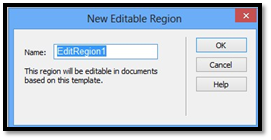
Click OK.
When you're finished designing the page and have specified your editable regions, relieve your file.
The Dreamweaver Library
A library is a Dreamweaver file that contains all the assets (files, images, etc.) that yous put in your certificate and on your spider web page. These avails are called library items. What makes the library and so user-friendly is that when y'all edit i asset in the library, you can automatically update all the pages that contain that asset.
Your library items are stored in your library inside the local root binder for each site that y'all create. This means that each site you create in Dreamweaver has its own library. Library items can exist created from any attribute or element in the body of a document. This includes text, forms, tables, applets, plug-ins, navigation bars, images, etc.
Creating Library Items
You must create library items in social club for them to be stored in the library. To practice then, get to the library by going to the Assets panel (Window>Assets).
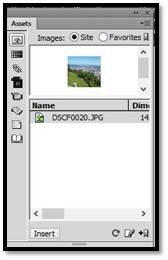
Click  .
.
And then select the detail that you want to appear in the library and drag it to the library category. You lot tin likewise click the New Library Item at the bottom of the panel.
Insert a Library Detail into a Document
Whenever you lot utilise a library item in your document, Dreamweaver inserts a link to it in the spider web folio. To make that easier to understand, Dreamweaver inserts the HTML source code for the item into the document, and so adds a annotate that contains a reference to the original item. This is why it is possible to update all instances of the library particular.
To insert a library detail into your document:
- Click in the certificate to create an insertion betoken.
- Click the Library icon in the Assets panel.
- Select the library particular, so click Insert.
Edit a Library Particular
Remember that when you lot update a library particular, you can as well update all instances of information technology within your document.
To edit a library item:
Go to the Library category in the Assets panel.
Select the library detail that yous want to edit.
Double click the library item.
At this betoken, a new window will open.
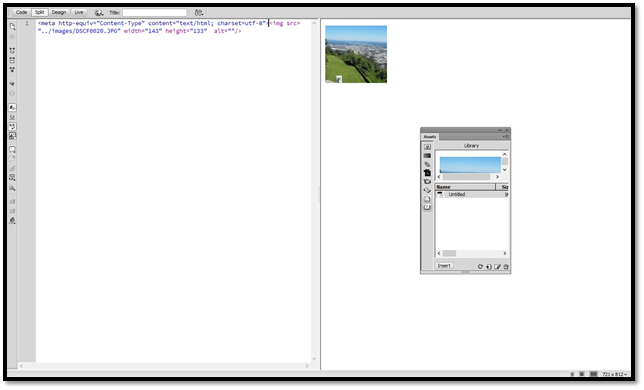
Consummate your edits. Your edits will appear as inline fashion. When you're finished, save the file. You lot'll then be asked if you lot want to update all instances of the library item in your documents.
The Assets Panel
You use the Avails console to manage and view your assets inside a electric current site. The panel just shows assets associated with the agile document.
You can view your avails in two dissimilar means. Site List shows all avails on your site. This includes colors and URLs. The Favorites List only shows avails that you've selected. Utilize the radio buttons to switch between these two different views.
Assets fall into one of the categories listed below. You can click on the category to view all assets within it. The nugget icons announced vertically down the left side of the Avails panel.
Images. These include GIF, JPEG, and PNG.
Colors. This includes all colors used in your documents and style sheets. It includes the colors of the text, backgrounds, and links.
URLs. Links in your documents linking to exterior sources. These links include FTP, gopher, HTTP, HTTPS, JavaScript, electronic mail, and local file links.
Wink. All Flash files in SWF.
Shockwave. Adobe Shockwave files.
Movies. These include QuickTime or MPEG files.
Scripts. This applies just to JavaScript or VBScript files. HTML files practise not appear anywhere in the Assets panel.
Templates. Templates include page layouts that are used on multiple pages.
Library Items. These are aspects of your site that you utilize on multiple pages.
Employ Tracing to Design Website Pages
You can also use another website or graphic to create your web folio. When you practice this, you will trace the other design, placing yours on top of information technology. This tin can make creating a blueprint you want easier.
To do this, start a new HTML page. Click on Page Properties in the Property Inspector and get to the Tracing Image category.
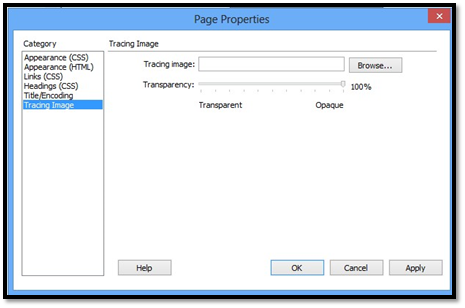
Find the file on your reckoner that you desire to trace, then set the transparency, or how dark it volition announced on your folio. You're going to want it to appear lighter, well-nigh like the tracing paper you used when you were a kid. Try setting yours at fifty% or lower.
Then, you can just trace over the image. When you're tracing a website layout, ready all margins and padding to zero then the images line upwardly completely.
When you're finished, remove the tracer prototype.
Tracer Images for Text
In that location may be times you desire to write text over an image. Yous tin can also apply the tracing images feature for that as well.
Select your picture show.
Yous'll desire a darker transparency for this.
Click OK and your image volition announced in your document.
Now yous tin type text over it.
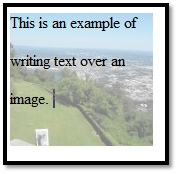
HTML Tables
Merely a few years agone, yous used tables to design web pages. You lot can withal practise that if you lot don't want to use CSS. Nevertheless, tables are now used in web design to include spreadsheet data and things of that nature.
In this article, nosotros're going to cover how to add a table to your document.
Creating a Table
To create a table in your HTML document, outset click on the place in the document where yous desire to insert the table. We're going to insert one at the meridian of the document.
Equally y'all can see below, we are in Design View.
Become to Insert> Table.
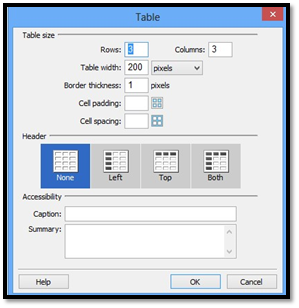
In this dialogue box, nosotros're going to enter the attributes for our outset tabular array.
- We want to make this tabular array 3 rows in width, and then we'll enter three.
- We're going to enter a iii for the number of columns. Columns run vertical on the page.
- For the Table Width, we're going to enter 200. We want this to be measured in pixels, then we'll select Pixels from the pop up menu.
- Enter i for Border Thickness. 1 is a sparse border. If nosotros wanted thicker, nosotros'd enter a college number.
- Enter 0 in the Prison cell Padding box. Cell padding adds white infinite within a cell, with equal white space on top, bottom, left, and right.
- Enter 0 for Cell Spacing. This is the space between cells.
We don't want a header, so we'll get out that on None.
If we wanted, nosotros could add a caption and a summary of the tabular array'due south contents. However, for this article, leave those blank.
Click OK.
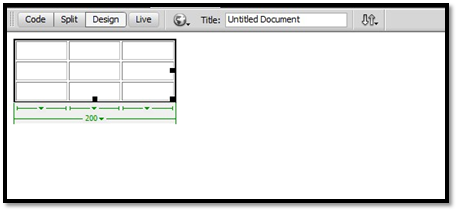
You tin now see the table in our certificate. You lot can drag on the border of any row or column to resize it.
If you look at the tabular array, you'll come across the table width in the Table selector, which is indicated by green lines. This appears when the table is selected or when an insertion bespeak is in the table.
Look next to the widths. These are arrows for the tabular array header menu and the cavalcade header menus. These menus can exist used for quick admission to table commands. To disable or enable the widths and bill of fare displays, go to View> Visual Aids> Table Widths.
Click to the right of the tabular array (outside of the tabular array) to deselect it.
Adding Text to a Table
To add text to a table, click within the jail cell where you want to add text. Start typing.
Formatting Cells within a Table
You tin format the cells inside the table just every bit you can format the tabular array (as you'll acquire to practice in only a minute).
To format cells, click within a jail cell, then become to the Holding Inspector.

Use Horz and Vert to position text within the jail cell. Using the Horz field, y'all tin position information technology left, center, and correct. Using the Vert field, you can position information technology top, middle, bottom, and baseline.
Enter a width for the jail cell in the W field. Enter a acme for the jail cell in the H field.
In the Bg field, you can set a background colour for the jail cell.
Setting Table Backdrop and the Belongings Inspector
Now we're going to set the properties for our tables. Make sure the table is selected in lodge for you to exist able to do this.
Go to the Backdrop Inspector, pictured below.
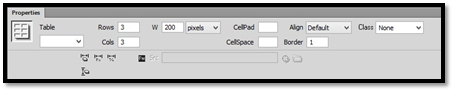
The Properties Inspector allows u.s.a. to edit the tabular array properties.
As you lot tin can meet in the snapshot higher up, the Table Property Inspector allows you to customize the following attributes:
-
ID
-
Rows and columns
-
Width
-
Cell padding and cell spacing
-
Alignment
-
Border
-
CSS Class
-
Articulate Column Widths or Heights
-
Convert Tabular array Widths to Pixels
-
Catechumen Tabular array Widths to Per centum (of page)
-
Source
Placing Images and Graphics into Tables
To insert an paradigm or graphic into a tabular array, offset click the cell where y'all want to add together the prototype or graphic.
Go to Insert>Prototype.
NOTE TO CC USERS:
Become to Insert>Image>Prototype.

How To Make Dreamweaver Cs6 Update Template,
Source: https://www.universalclass.com/articles/computers/templates-in-dreamweaver-cs6.htm
Posted by: austinyouthisesir87.blogspot.com
0 Response to "How To Make Dreamweaver Cs6 Update Template"
Post a Comment