

How To Draw A Crystal Field Splitting Diagram
What is Crystal Field Theory?
Crystal field theory describes
the internet change in crystal energy resulting from the orientation of d orbitals of a transition metallic cation inside a coordinating grouping of anions besides called ligands.
A major characteristic of transition metals is their tendency to grade complexes. A complex may be considered as consisting of a cardinal metal atom or ion surrounded by a number of ligands. The interaction betwixt these ligands with the key metal atom or ion is subject to crystal field theory.
Crystal field theory was established in 1929 treats the interaction of metal ion and ligand as a purely electrostatic miracle where the ligands are considered equally point charges in the vicinity of the atomic orbitals of the cardinal atom. Development and extension of crystal field theory taken into account the partly covalent nature of bonds between the ligand and metal cantlet mainly through the application of molecular orbital theory. Crystal field theory often termed as ligand field theory.
Overview of Crystal Field Theory
In order to understand clearly the crystal field interactions in transition element complexes, it is necessary to take knowledge of the geometrical or spatial disposition of d orbitals. The d-orbitals are fivefold degenerate in a free gaseous metal ion. If a spherically symmetric field of negative ligand filed charge is imposed on a central metal ion, the d-orbitals will remain degenerate but followed by some changes in the energy of free ion.
A summary of the interactions is given below.
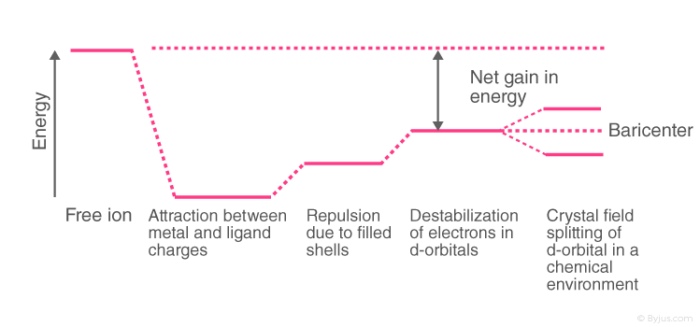
Crystal Field Splitting
Crystal field theory was proposed which described the metallic-ligand bond as an ionic bond arising purely from the electrostatic interactions betwixt the metal ions and ligands. Crystal field theory considers anions as indicate charges and neutral molecules as dipoles.
When transition metals are non bonded to any ligand, their d orbitals are degenerate that is they accept the same energy. When they showtime bonding with other ligands, due to dissimilar symmetries of the d orbitals and the inductive effect of the ligands on the electrons, the d orbitals split apart and become non-degenerate.
Loftier Spin and Low Spin
The complexion with the greater number of unpaired electrons is known every bit the high spin complex, the depression spin circuitous contains the lesser number of unpaired electrons. High spin complexes are expected with weak field ligands whereas the crystal field splitting energy is small Δ. The opposite applies to the low spin complexes in which strong field ligands crusade maximum pairing of electrons in the ready of three t2 atomic orbitals due to big Δo.
- High spin – Maximum number of unpaired electrons.
- Depression spin – Minimum number of unpaired electrons.
Example: [Co(CN)6]iii- & [CoF6]three-
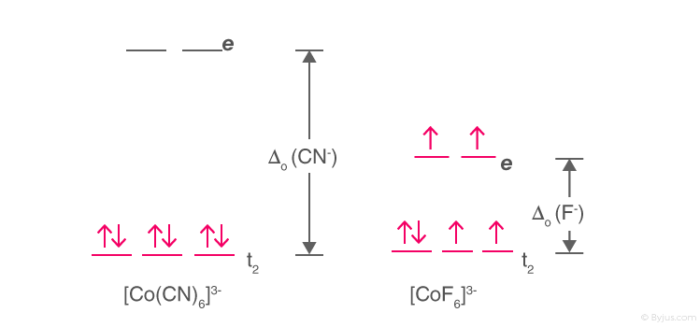
High Spin and Depression Spin Complex
- [Co(CN)vi]3-– Low spin complex
- [CoFvi]3-– High spin complex
Recommended Videos

The pattern of the splitting of d orbitals depends on the nature of the crystal field. The splitting in various crystal fields is discussed beneath:
Crystal Field Splitting in Octahedral Complex
- In the case of an octahedral coordination chemical compound having six ligands surrounding the metal atom/ion, we observe repulsion between the electrons in d orbitals and ligand electrons.
- This repulsion is experienced more in the case of dx2-ytwo and dzii orbitals as they point towards the axes along the management of the ligand.
- Hence, they accept higher energy than boilerplate free energy in the spherical crystal field.
- On the other hand, dxy, dyz, and dxz orbitals experience lower repulsions as they are directed between the axes.
- Hence, these 3 orbitals accept less free energy than the average energy in the spherical crystal field.
Thus, the repulsions in octahedral coordination compound yield two energy levels:
- t2g– set of three orbitals (dxy, dyz and dxz) with lower free energy
- eg – set up of ii orbitals (dten2-y2 and dz2 ) with higher energy
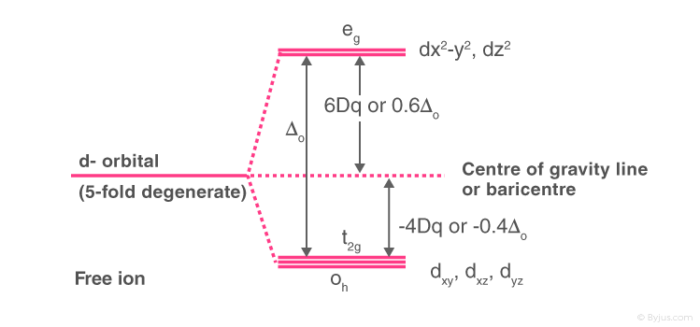
Crystal Field Splitting in Octahedral Complex
This splitting of degenerate level in the presence of ligand is known every bit crystal field splitting . The divergence between the energy of t2g and echiliad level is denoted past "Δo" (subscript o stands for octahedral). Some ligands tend to produce strong fields thereby causing large crystal field splitting whereas some ligands tend to produce weak fields thereby causing pocket-size crystal field splitting.
Crystal Field Splitting in Tetrahedral Circuitous
The splitting of fivefold degenerate d orbitals of the metal ion into 2 levels in a tetrahedral crystal field is the representation of two sets of orbitals equally Td. The electrons in dxtwo-y2 and dz2 orbitals are less repelled past the ligands than the electrons present in dxy, dyz, and dxz orbitals. As a outcome, the energy of dxy, dyz, and dxz orbital prepare are raised while that os the d10two-y2 and dz2 orbitals are lowered.
- There are just four ligands in Td complexes and therefore the total negative charge of four ligands and hence the ligand field is less than that of 6 ligands.
- The management of the orbitals does not coincide with the directions of the ligands approach to the metal ion.
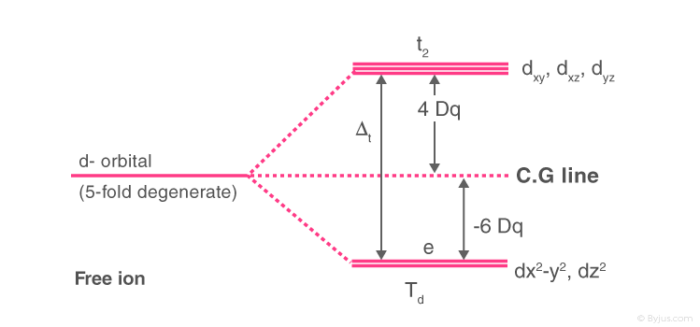
Crystal Field Splitting in Tetrahedral Complex
Thus, the repulsions in tetrahedral coordination compound yield two energy levels:
- t2– set of three orbitals (dxy, dyz and dxz) with higher energy
- east – set of 2 orbitals (dxtwo-y2 and dz2 ) with lower free energy
The crystal field splitting in a tetrahedral complex is intrinsically smaller in an octahedral filed because there are just two thirds every bit many ligands and they have a less direct effect of the d orbitals. The relative stabilizing effect of east ready will exist -6Dq and the destabilizing effect of t2 set will be +4Dq
Crystal Field Stabilization Free energy
In a chemical environment, the energy levels generally split as directed by the symmetry of the local field surrounding the metallic ion. The free energy departure between the eg and t2g levels is given as or 10Dq. It states that each electron that goes into the lower t2g level stabilizes the arrangement past an amount of -4Dq and the electron that goes into ethou level destabilizes the system past +6Dq. That is the t2g is lowered by 4Dq and the eg level is raised by +6Dq.
For example, the net change in free energy for d5 and dten systems will be zippo as shown below.
d5 :- 3(-4Dq) + 2(+6Dq) = -12Dq + 12Dq = 0
d10 :- half dozen(-4Dq) + four(+6Dq) = -24Dq + 24Dq = 0
The decrease in energy caused by the splitting of the energy levels is called the "Ligand Field Stabilization Energy (LFSE)".
Crystal Field Stabilization Energy Table
The crystal field stabilization energies for some octahedral and tetrahedral complexes of 3d metallic ions are tabulated below.
| Electronic Configuration | Octahedral Complex | Tetrahedral Circuitous | ||
| Weak Field (-Dq) | Stiff Field (-Dq) | Weak Field (-Dq) | Strong Field (-Dq) | |
| d0 | 0 | 0 | 0 | 0 |
| d1 | iv | iv | half-dozen | 6 |
| dii | 8 | 8 | 12 | 12 |
| d3 | 12 | 12 | 8 | (xviii)* |
| dfour | half-dozen | 16 | iv | (24)* |
| d5 | 0 | xx | 0 | (20)* |
| d6 | 4 | 24 | 6 | (16)* |
| dseven | 8 | 18 | 12 | 12 |
| d8 | 12 | 12 | viii | 8 |
| d9 | 6 | vi | 4 | 4 |
| d10 | 0 | 0 | 0 | 0 |
Thus, the crystal field splitting depends on the field produced by the ligand and the accuse on the metal ion. An experimentally adamant series based on the absorption of light by coordination compound with different ligands known as spectrochemical serial has been proposed. Spectrochemical series arranges ligands in order of their field strength as:
I–< Br–< Cl–< SCN–< F–< OH–< CiiOiv 2-< H2O < NCS–< EDTA4- < NH3 < en < CN–< CO
Filling of d-orbitals takes place in the post-obit manner; the kickoff iii electrons are arranged in t 2g level as per the Hund's dominion. The fourth electron can either enter into t 2g level giving a configuration of t 2g 4 e g 0 or can enter the echiliad orbital giving a configuration of t 2g iii e thou ane. This depends on two parameters magnitude of crystal field splitting, Δo and pairing energy, P. The possibilities of two cases can better exist explained as:
- Δo > P – Electron enters in the t 2g level giving a configuration of t 2g 4 eastward thou 0. Ligands producing this configuration are known every bit stiff field ligands and course low spin complexes.
- Δo < P – Electron enters in the eg level giving a configuration of t 2g 3 east g 1. Ligands producing this configuration are known as weak field ligands and form high spin complexes.
Larn more about the Limitations of Crystal Field Theory with BYJU'S.

Source: https://byjus.com/chemistry/crystal-field-theory/
Posted by: austinyouthisesir87.blogspot.com
0 Response to "How To Draw A Crystal Field Splitting Diagram"
Post a Comment